HOA Parking Enforcement and Towing Policy Guide
How OC HOA boards should structure parking enforcement and towing policies that are legally defensible, consistently applied, and clearly communicated to residents.
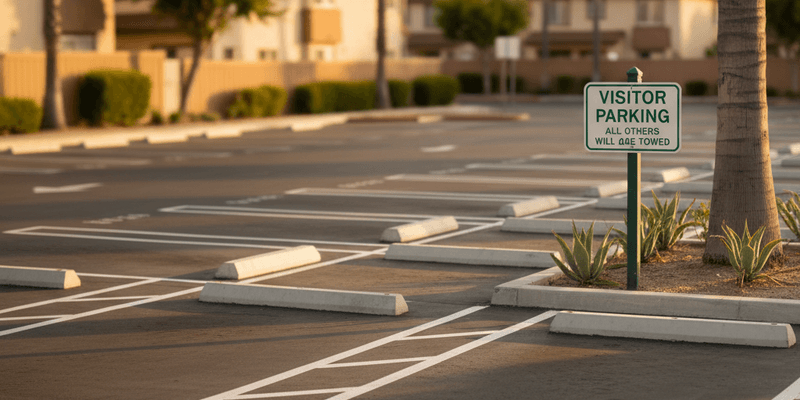
Parking disputes generate more homeowner complaints than almost any other community issue. Boards that enforce parking rules inconsistently — or that authorize towing without proper procedures — create legal exposure and resident resentment that far exceeds the original violation.
A defensible parking enforcement program requires clear rules, documented notice, and a towing process that complies with California Vehicle Code requirements.
Establishing enforceable parking rules
Before the association can enforce parking violations, the rules must be properly adopted. Under the Davis-Stirling Act, operating rules (including parking regulations) must go through the rulemaking process outlined in Civil Code § 4340–4370, which includes member notice and a comment period.
The parking rules should clearly address:
- which spaces are assigned, guest, or common,
- vehicle types prohibited from parking on the property (inoperable vehicles, commercial trucks, recreational vehicles),
- time limits for guest parking,
- overnight parking restrictions,
- whether charging stations or EV-assigned spaces exist, and
- the specific consequences for violations — warnings, fines, and towing eligibility.
Vague rules like "no improper parking" are unenforceable. The rule must describe the prohibited conduct in terms specific enough that a reasonable resident can understand what is and is not allowed.
California towing requirements
California Vehicle Code § 22658 governs towing from private property, including HOA common areas. Key requirements include:
- Signage. The property must have signs posted at each entrance stating that unauthorized vehicles will be towed, including the towing company's name and telephone number. Signs must meet specific size and content requirements.
- Authorization. The property owner or authorized agent must request the tow. For HOAs, this is typically the community manager or an authorized board designee — not individual homeowners.
- One-hour rule. For most violations, the vehicle must be parked in violation for at least one hour before towing, unless it is blocking a fire lane, access road, or designated accessible space.
- Tow company requirements. The towing company must accept credit cards, provide an itemized receipt, and allow the vehicle owner to retrieve the vehicle within specified hours.
Associations that tow vehicles without following these requirements face liability for wrongful tow claims, including statutory damages.
Building a graduated enforcement process
Effective parking programs use escalation before towing:
- First violation: written warning placed on the vehicle and sent to the unit owner of record, describing the violation and the applicable rule.
- Second violation within 60 days: formal notice with a fine schedule, sent via the association's enforcement process.
- Third violation or persistent noncompliance: towing authorization, with documentation showing prior warnings were issued and the owner had opportunity to cure.
This graduated approach protects the board from claims of arbitrary enforcement and creates a paper trail if the matter escalates to a hearing or legal dispute.
Guest parking management
Guest parking is a flashpoint in dense communities. The board should define a guest parking policy that specifies:
- the maximum number of consecutive days a guest vehicle may park,
- whether guest permits or registration are required,
- how residents request extended guest accommodations, and
- the process for reporting suspected abuse of guest spaces.
Boards should avoid policies that make guest parking so restrictive that residents feel harassed — the goal is to prevent abuse, not to eliminate hospitality.
Use the resident notice escalation matrix when parking violations require progressively stronger communication, and the CCR enforcement workflow for violations that extend beyond parking into broader rule-enforcement proceedings.
Ready to hire?
Browse vetted vendors in our Orange County directory.